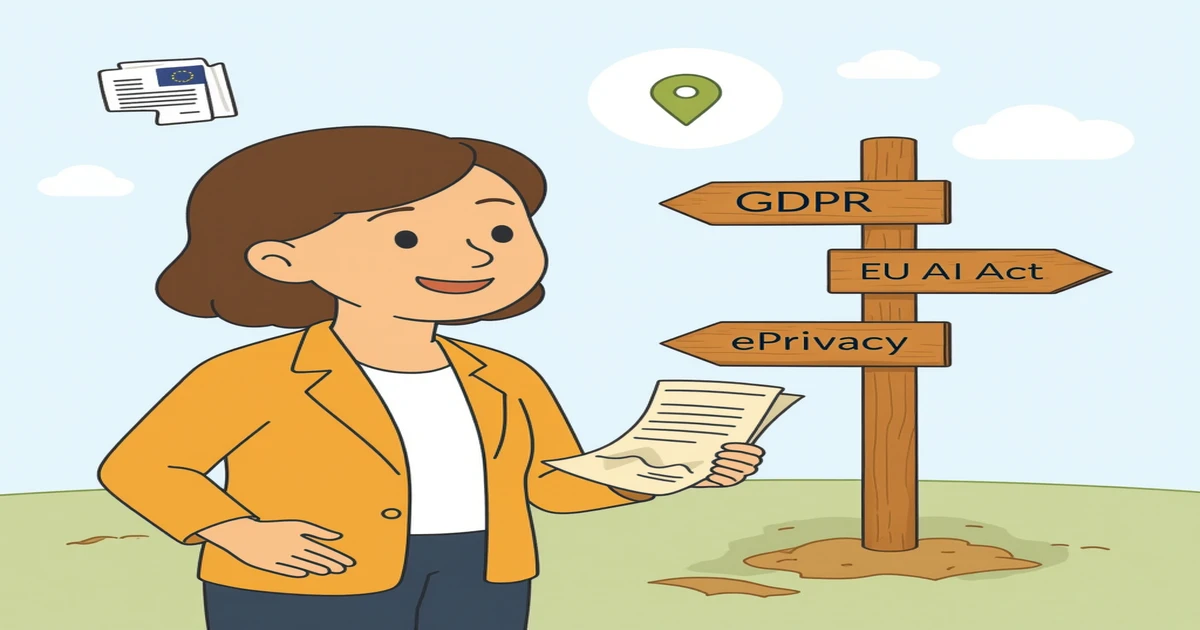
Which EU data protection laws apply to your business?
GDPR, AI Act, Compliance, SMB
You start researching GDPR compliance. Then someone tells you that you also need to think about the AI Act. Then a customer mentions ePrivacy. And then there is the UAVG, the Autoriteit Persoonsgegevens, and something about NIS2.
Are these all separate things you need to comply with? And where do you even begin?
This article gives you an overview. Which European privacy laws exist, which ones are relevant to your business, and what does each one require in practice?
GDPR: the baseline for anyone processing personal data
GDPR is the starting point. If you process personal data of people in the EU, and you almost certainly do if you have a business with customers, employees, or a website, then GDPR applies to you.
GDPR sets rules for:
- What personal data you may collect and for what purpose
- The lawful basis for processing (consent, contract, legitimate interest, legal obligation)
- How long you may keep the data
- The rights of data subjects (access, correction, deletion)
- What security measures you must take
- What to do in the event of a data breach
GDPR applies regardless of the size of your organisation. A freelancer with a client list falls under GDPR. A three-person startup with a website falls under GDPR. There is no threshold based on number of employees or revenue.
What does differ based on size: larger or specific organisations are required to appoint a Data Protection Officer (DPO). For most small SMBs, this is not the case.
The foundation of GDPR compliance is the processing register: an overview of all activities through which you process personal data.
The Dutch UAVG: the national implementation of GDPR
The UAVG (Uitvoeringswet Algemene Verordening Gegevensbescherming) is the Dutch law that supplements GDPR. GDPR is an EU regulation that applies directly, but it leaves member states room to fill in certain points at national level. The UAVG fills in that space for the Netherlands.
Practical implications for Dutch businesses:
- The minimum age for children's consent is 16 in the Netherlands (GDPR allows each member state to set it between 13 and 16)
- The Autoriteit Persoonsgegevens (AP) is designated as the national supervisory authority
- There are specific implementing rules for the public sector, media, and scientific research
For most SMBs, the distinction between GDPR and the UAVG is not relevant in practice. Complying with GDPR means you are largely complying with the UAVG as well. You do not need to treat them as two separate projects.
The EU AI Act: for anyone using or developing AI systems
The EU AI Act entered into force in August 2024. The law is being phased in: the first obligations are already active (prohibited AI practices), and the most significant provisions for high-risk AI become enforceable from August 2026.
The AI Act applies to:
- Providers: organisations that develop or place AI systems on the market
- Deployers: organisations that use AI systems from others in their operations
As an SMB, you are most likely a deployer. That means you are using an AI tool (via SaaS or an API) in your business processes.
The obligations depend on the risk class of the AI system:
- Minimal risk (e.g. spam filters, recommendation systems): almost no additional obligations
- Limited risk (e.g. chatbots): transparency obligation toward users
- High risk (e.g. CV screeners, credit assessment, surveillance systems): extensive documentation, human oversight, risk management, and registration
The practical question for you as an SMB: which AI tools do you use? Are there systems that make decisions affecting people? If yes, the AI Act is actively relevant.
Start with an AI inventory to know what you have. From there you can determine which obligations apply.
ePrivacy: for anyone using cookies, email, or phone marketing
The ePrivacy Directive is the law that specifically covers electronic communications and tracking. In the Netherlands, it is implemented through the Telecommunications Act.
ePrivacy rules touch three areas that almost every SMB will recognise:
Cookies and tracking. For non-essential cookies on your website (analytics tools, advertising cookies, social media buttons), you need consent from the visitor. That is the reason for the cookie banner. Essential cookies (for the basic functioning of the website) are not covered by this requirement.
Direct marketing by email or SMS. For email marketing to individuals, you need opt-in consent. Someone must have actively indicated that they want to receive messages. This applies to B2C marketing. For B2B marketing to business email addresses, the rules are slightly more flexible, but there are still limits.
Confidentiality of communications. Electronic messages are confidential. You cannot monitor employee communications without a lawful basis and transparency.
Note: the ePrivacy Regulation intended to replace the directive is still under discussion in the EU legislature as of 2026. Until it is in force, the existing directive via national law still applies.
NIS2 and the Dutch Cyberbeveiligingswet: for larger organisations in critical sectors
NIS2 is the European directive for the security of network and information systems. The Dutch implementation (Cyberbeveiligingswet) is expected in the first half of 2026.
NIS2 applies to organisations with 50 or more employees or more than EUR 10 million in revenue that are active in one of 18 designated sectors, including energy, healthcare, transport, digital infrastructure, and managed IT services.
For most small SMBs, NIS2 does not apply directly. However, customers who are in scope for NIS2 may ask you for evidence of your security practices as part of their supply chain obligations.
This article does not go deeper into NIS2. If you want to know whether your business is in scope, read our article on checking your NIS2 status.
How do you know which laws apply to your business?
Four quick questions to help you identify the relevant laws:
Do you process personal data of people in the EU? If yes: GDPR and UAVG apply. This is almost always the case if you have customers, employees, or a website.
Do you use AI systems in your business operations? If yes: EU AI Act applies as a deployer. Build an inventory and determine the risk class per system.
Do you use cookies on your website or send email marketing? If yes: ePrivacy rules via national telecommunications law apply. Review your cookie banner and opt-in procedures.
Do you have 50 or more employees and work in a regulated sector? If yes: check whether you fall under NIS2. If no: check whether you have customers who are in scope and are therefore likely to ask you questions.
For most Dutch SMBs, the practical picture is: GDPR and UAVG as the baseline, the EU AI Act if they use AI tools, and ePrivacy if they have a website with cookies or send email marketing.
What is the Autoriteit Persoonsgegevens and what does it do?
The Autoriteit Persoonsgegevens (AP) is the Dutch supervisory authority for GDPR, the UAVG, and ePrivacy. The AP:
- Issues guidance and interpretation on how the rules apply in the Netherlands
- Handles complaints from citizens about suspected GDPR violations
- Conducts investigations into organisations on its own initiative
- Can impose fines of up to EUR 20 million or 4% of global annual turnover for the most serious violations
The AP also publishes accessible guidance on its website (autoriteitpersoonsgegevens.nl, available in Dutch). If you are uncertain about how a GDPR rule applies in your situation, the AP website is a reliable first source.
A practical priority order
If you are not sure where to begin, follow this sequence:
Step 1: GDPR. Build a processing register. Know which personal data you process, for what purpose, and on what lawful basis.
Step 2: If you use AI tools, build an AI inventory and determine which obligations apply per system under the AI Act.
Step 3: Review your website for cookie consent and your email lists for valid opt-ins (ePrivacy).
Step 4: If you have customers asking NIS2 questions, make sure you have basic security documentation that can answer those questions.
ComplianceHive helps you document your obligations under GDPR and the AI Act in one platform. Try free for 30 days.
This article is general information and not legal advice. Consult a qualified lawyer or privacy specialist for an assessment specific to your situation.